
NJDOC State Custody Records
The New Jersey Department of Corrections goes by NJDOC on its own pages. Its offender search is the lookup for state prison and state custody. It is not a statewide arrest-photo file. One arrest can leave traces in several places: a county booking record, a short county stay, a court case, and perhaps a state sentence later. Different agencies hold those pieces at different stages. Someone just arrested, held before trial, or released from a county jail will not show up here simply because the arrest happened in New Jersey.
A NJDOC profile answers a different question. It tells you whether a person sits in the state system and what sentence and custody details the public profile lists. When a photo appears, it is an NJDOC offender photograph. Do not relabel it as a county booking photo. The two images come from separate records, made at different stages, under different release rules. The county agency owns the local arrest and booking layer. NJDOC owns its state-custody profile and picture.
A name match is a lead, not an identity. Common names can return several results, and aliases can change how a profile shows up. Compare the visible fields before you rely on any match. If no profile appears, the person may sit in another custody layer, have left the public search, or have a record another agency holds.
Open the NJDOC Offender Search
Start at the official NJDOC Offender Information page and pick the Incarcerated Person Search Engine. That choice opens a separate search application. Go this route for a state-custody profile rather than a copied form or third-party index. The launch page and the application can both be reached from the official source even when the search tool lives on a different state address.
The state page keeps offender information apart from other corrections topics. A parole notice, facility page, or absconder list answers a different question, so follow the person-search link and open the profile itself. The official Offender Information screen shows where the state places the public search launch among its corrections services.
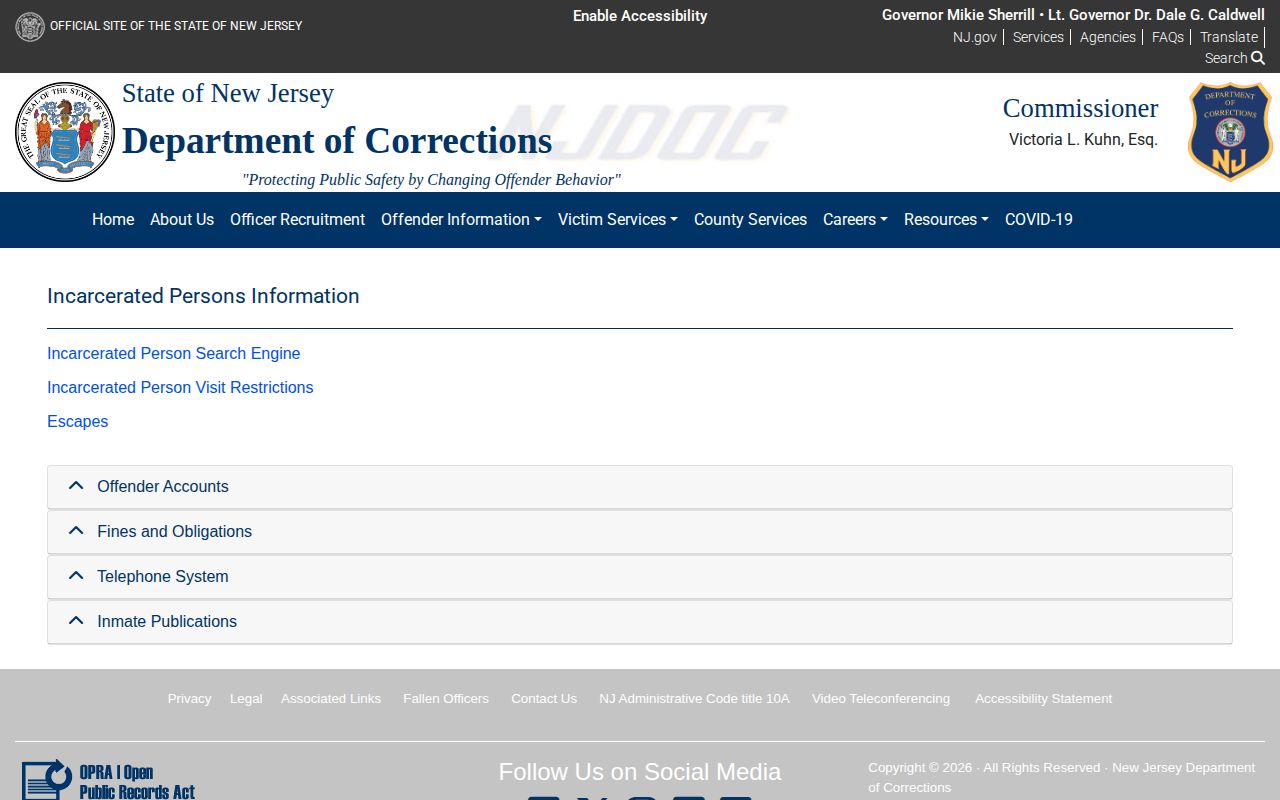
The launch page routes you to the search application; it is not a county arrest roster. Keep the originating agency in mind when you compare a state profile with a local booking entry. The direct NJDOC search launch displays the agency's own notice about the limits and update pattern of its public information.
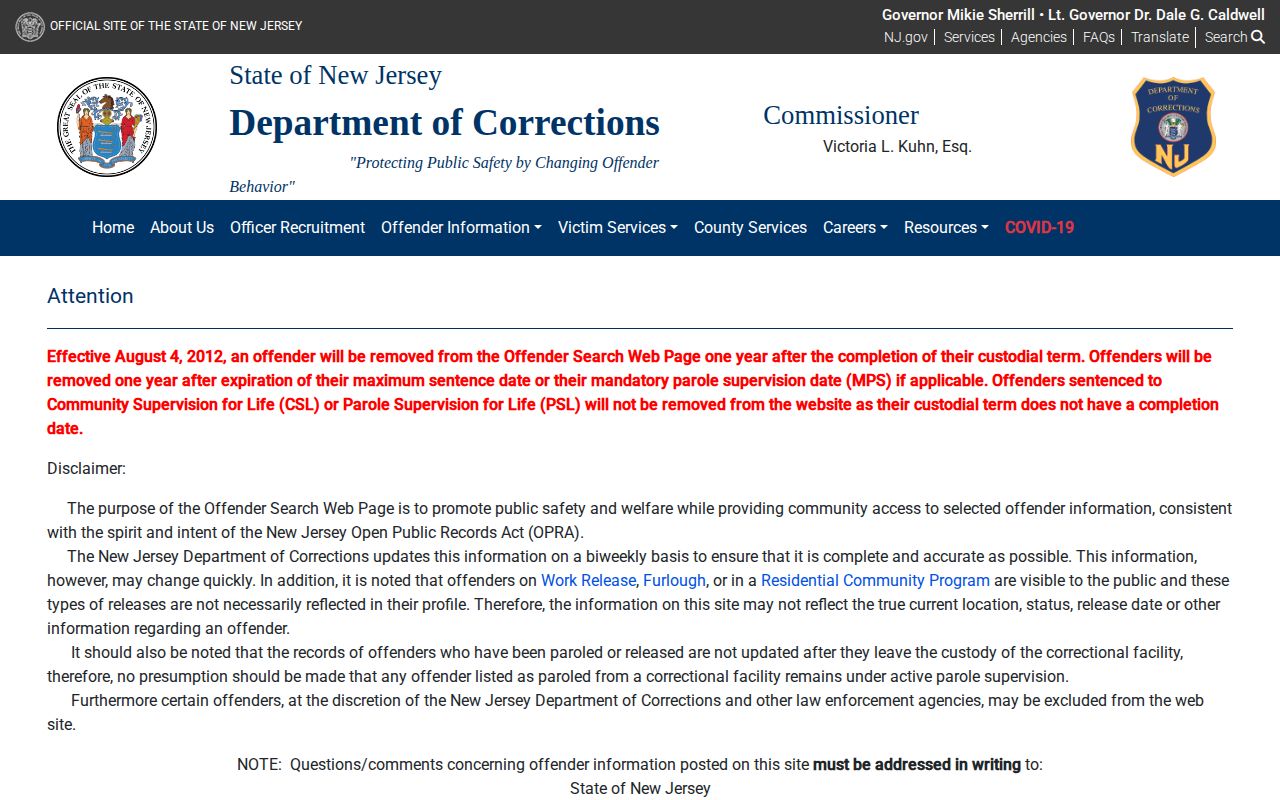
Treat the result as a current public view. It is not a complete history. A transfer, release, parole event, or correction can change the profile at any time. Run the search in a short sequence. That way a similar name never turns into a false match.
- Open the state search from the NJDOC Offender Information page or its direct official launch.
- Enter the name or alias the live form accepts. If the known SBI number is available, use it as a stronger identifier than a common name.
- Review each possible result and compare the listed aliases, sex, physical descriptors, and county of commitment.
- Open the profile that best fits those details, note the retrieval date, and read the custody and sentence fields with the photo.
The help page defines the SBI number as the state identification number assigned to the person. Never guess its format or assume a filter exists unless the live form shows one. No match? Try a known alias or SBI number. Then consider county, federal, immigration, or court records.
Note: NJDOC's public notice says its information changes, so a saved result should always carry the date it was retrieved.
Match NJDOC Search Fields
NJDOC's help materials spell out the identity details that separate a real profile from a name-only match. Use the fields the live search actually displays, and never guess at controls or number formats. The official NJDOC help page lists definitions for the search and profile terms the state uses.
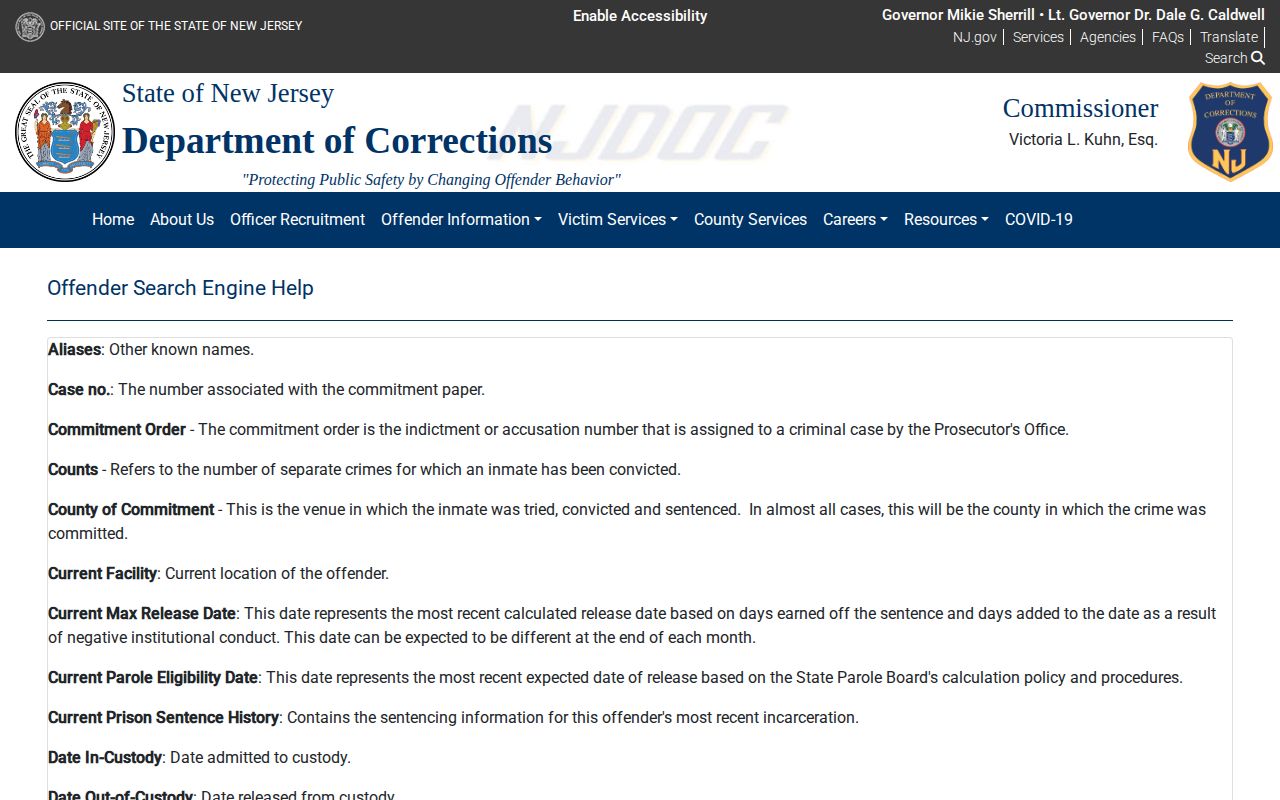
Those definitions keep identity numbers apart from court case labels, and current custody apart from the county where a person was sentenced.
| Search detail | What it means | How to use it |
|---|---|---|
| Name | The name shown for the person in the state search. | Check the full result, not only the first and last name. |
| Aliases | Other known names associated with the profile. | Use a known alias if the main name does not return a clear result. |
| SBI number | The state identification number assigned to the person. | When known, it can distinguish a person from others with a common name. |
| Visible identifiers | Profile details such as sex, physical descriptors, and county of commitment. | Compare more than one detail before treating the record as a match. |
An SBI number helps only when it comes from a reliable record. A guess helps no one. Without it, a name search calls for a closer look at aliases and profile details. County of commitment means something different from current facility. It usually names the county where the case was tried, convicted, and sentenced.
The public search notice says the information is updated biweekly. It may also change quickly. That notice covers the whole profile, not a photo-only refresh schedule. A Work Release, Furlough, or Residential Community Program stint may not appear in the profile at all. The notice also warns that release records stop updating after facility custody. An old parole label proves nothing about active supervision.
Read an NJDOC Offender Profile
The NJDOC Offender Search Engine Help page explains what each profile label means. Identity comes first. Then the court commitment, custody dates, the sentence, and any calculated release terms. Physical traits recorded at admission round it out. A web photo, if one appears, sits inside that profile record. Keep one thing straight: these fields describe a state sentence and custody history, not the charge list from a fresh county arrest.
Read the labels on their own terms. “County of Commitment” names a venue. “Current Facility” names a place. The State Parole Board calculates the “Current Parole Eligibility Date,” and the maximum release date can shift as credits or conduct change the math. Treat none of these dates as a promise of release.
| Profile field | Official meaning | Careful reading |
|---|---|---|
| Aliases | Other known names. | Use these to check identity; an alias alone does not establish a match. |
| Case number | The number associated with the commitment paper. | Keep it separate from the SBI number. |
| Commitment Order | The indictment or charge number assigned to a criminal case by the Prosecutor's Office. | It identifies the case record, not a new booking. |
| Counts | The number of separate crimes for which the person was convicted. | Counts are convictions in this profile context, not an arrest charge total. |
| County of Commitment | The venue where the person was tried, convicted, and sentenced; in most cases, the county where the crime was committed. | This is not the current custody location. |
| Current Facility | The current location of the person. | Recheck because transfers and release events can change the value. |
| Current Max Release Date | The latest calculated release date, adjusted for sentence days earned or added for negative institutional conduct. | NJDOC says this calculation can differ at the end of each month. |
| Current Parole Eligibility Date | The latest expected date of release based on State Parole Board calculation policy and procedures. | Eligibility is not the same as an actual release decision. |
| Current Prison Sentence History | Sentencing information for the most recent incarceration. | It may not describe every prior custody period. |
| Date In-Custody / Date Out-of-Custody | The date admitted to custody and the date released from custody. | Read each date with the current facility and the profile's update caveat. |
| Offense / Offense Date | The conviction offense, with the N.J.S.A. 2C code and description, and the date the crime occurred. | If an offense spans multiple dates, NJDOC displays the latest date. |
| SBI Number | The state identification number assigned to the person. | This is an identity field, not the commitment case number. |
| Sentence / Sentence Date | The years, months, and days imposed by the court, and the date the person appeared before the judge to be sentenced. | Use the court file for the later case outcome or a court correction. |
| Sex, height, weight, hair, and eye color | Sex as listed and physical traits recorded at admission. | These details can help distinguish records, but appearance can change. |
Some profiles carry a web photograph and some carry none. Admission traits describe the person at intake. Facility and calculated dates can move. When fields seem to clash, ask NJDOC for the record behind the disputed label.
Note: A case number, an SBI number, and a commitment order are distinct identifiers and should not be treated as interchangeable.
NJDOC Web Photos and Religious Coverings
An NJDOC web photo is a public profile image, nothing more. It is not a county booking photo. Department policy allows an incarcerated person with an approved religious head covering to wear it in the public website photograph. Other internal identification photos follow ordinary procedures.
That policy covers only the image chosen for public display. It does not put every identification photo online. Nor does it force the release of an internal image. When a profile shows no photo, the locator simply is not displaying one. Any request for a different image must name the record it seeks.
Call it an NJDOC offender web photograph. Skip guessing at its date. Guess only when the record states one. The public search can change. A former profile may fall under the visibility rule.
When Former NJDOC Profiles Leave Search
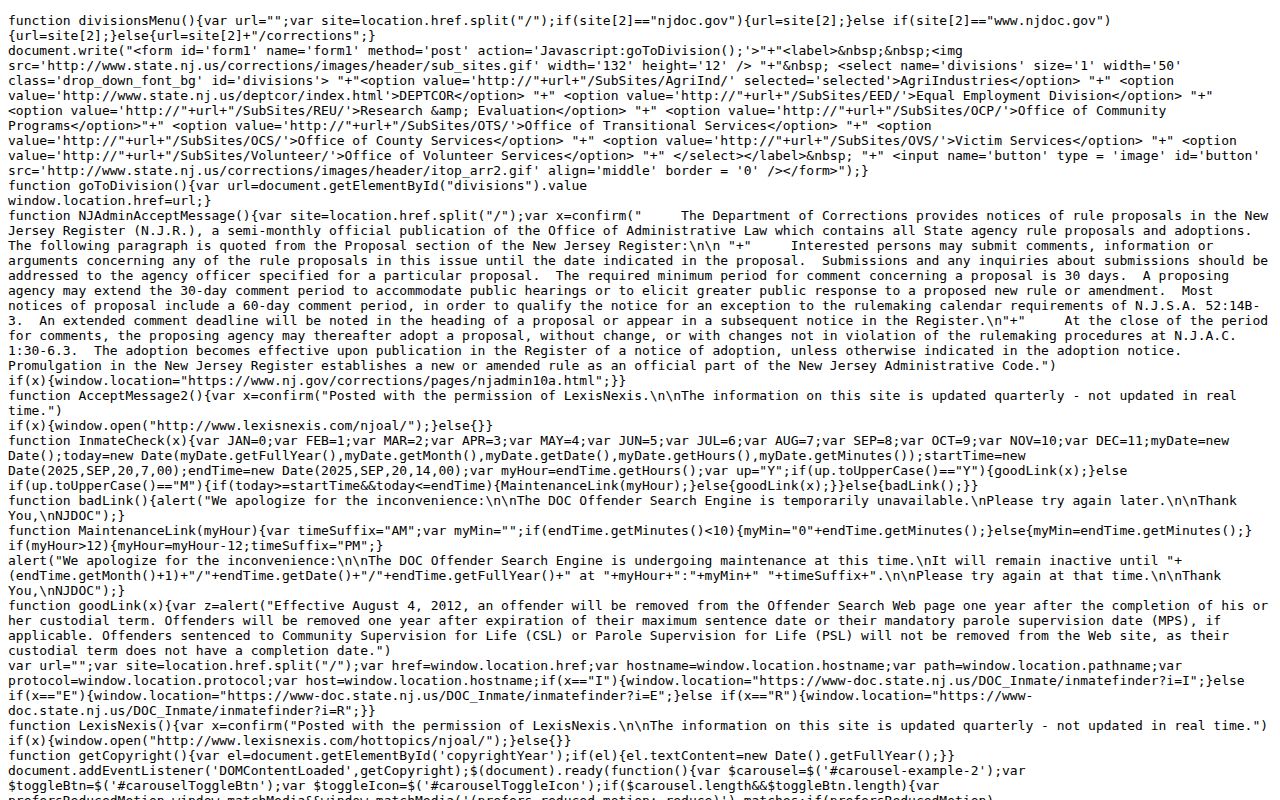
NJDOC's own launch script spells out when most former offenders drop from public view. The rule took effect August 4, 2012. Under it, the public Offender Search Web page removes a person one year after the custodial term ends. NJDOC measures that point from one year after the maximum sentence date expires. It can also run from the mandatory parole supervision date when one applies. The rule governs the public web page. That includes the profile and any web photo it carries.
One exception exists. A person sentenced to Community Supervision for Life or Parole Supervision for Life stays in place. The custodial term never formally completes. For everyone else, the clock runs from completion of the term. It does not run from the day a county roster stops listing custody.
The visibility rule comes from NJDOC's official search launch script. That script supplies the search link and its notice.
Vanishing from public search does not erase the record. Courts, parole, the State Police, and agency photo files each keep their own custodians and retention rules. When a profile disappears, ask its custodian for the record by name.
Note: A one-year public-search rule controls web visibility; it does not set the retention period for court, parole, or agency files.
Request NJDOC Records and Photos
When the locator shows no record or photo, NJDOC itself is the custodian. It holds the profile, admission record, identification image, or correction file. New Jersey's Open Public Records Act is the path for requesting an existing state record. The law is known as OPRA. A public profile does not open every underlying image to the public. Exemptions can affect access. So can the reason a record was created.
File through OPRA Central or follow NJDOC's current OPRA instructions from its official site. A strong request names the person and, if known, the SBI number. It should also state the record type plus a date or incarceration period. "Send every photo" is far too broad. Naming a particular web photograph, profile, admission or identification image, or disposition or correction record helps. It gives the custodian a clear path to the file.
Keep the request specific so the custodian can locate it:
- Choose NJDOC as the agency if the requested record was made or kept by the state corrections department.
- Give the person's name and any known alias or SBI number, plus the relevant date range or incarceration period.
- Name one existing record type, such as the public web photo, profile record, admission record, identification image, or a specific correction record.
- Ask for any reasonably separable non-exempt portion and, if access is denied or limited, the statutory basis for withholding.
The custodian has the final say on what the law permits. An arrest-information response timetable never guarantees release of every NJDOC photo. The public web photo is a different item from an internal identification image. For parole or absconder records rather than a prison photo, NJDOC's victim-services page can help. It points to State Parole Board public-information and OPRA routes.
An OPRA response covers the record asked for plus any lawful withholding. If a photo is missing from the locator, request that exact image from its custodian. Do not substitute another profile or notice.
NJDOC Photo vs County Booking
Match the source to the event and its custodian. A county booking photo comes from local intake. An NJDOC photo comes from a state-custody profile. Federal, immigration, parole, and court records each run on separate routes, and no single result fills another's gaps.
| Question | First official source | What the record can show |
|---|---|---|
| Recent arrest or county detention | Arresting agency and county corrections | Local booking, current county custody, or a county-held booking image when public under that agency's rules. |
| State custody or prison profile | NJDOC Offender Search | State facility, commitment, sentence, custody dates, and a public web photo when available. |
| Federal prison custody | Federal Bureau of Prisons locator | Federal custody location information; it is a separate system from NJDOC. |
| Immigration custody | ICE Online Detainee Locator | Immigration detention information, not a county booking or state prison profile. |
| Court case or disposition | New Jersey Courts public access | The court case and later outcome, subject to the court's access rules. |
| Parole or absconder information | State Parole Board route from NJDOC victim services | Parole-specific information, which is not the same as a prison photo record. |
For a new arrest, begin with the arresting agency and county source. The statewide New Jersey arrest and booking search overview explains how county rosters differ, and the New Jersey County Directory routes each search to a local area. NJDOC serves state custody. BOP or ICE covers their own systems. NJ Courts handles a court case or disposition.
Record distinction: A booking entry records an accusation and intake event. It does not prove guilt. A court disposition gives the later case outcome, and an NJDOC sentence profile concerns state custody. Compare those records without treating one as a replacement for another.
A photo that vanishes from one system has not vanished from the record itself. County rosters reflect current custody. Court files, by contrast, stay open under court rules long after a roster updates. When a result goes missing, contact the agency that holds the record. Ask what happened.