
Tracing New Jersey’s Old Mugshots
No single database holds every old New Jersey booking photo. The New Jersey State Archives is the official research center. It keeps records of lasting historical value. Its holdings are vast: more than 57,000 cubic feet of paper and more than 32,000 microfilm reels. The material dates back to 1664. Not every county booking image went there, though. A photo may still sit with the police or sheriff's office that took it. Others live in jail files, court exhibits, or correctional collections.
Start by working out which agency handled the arrest. Then find where the person was held. An old prison identification image can look exactly like a mugshot. Yet it documents correctional intake rather than the original arrest. Some commitment registers show a person entering custody with no photo at all. Local historical societies and newspaper archives can also point toward an agency file. Treat the State Archives as a statewide starting point, not the universal custodian. Need recent custody instead? The New Jersey busted mugshots home page offers the statewide arrest path for current bookings. Live rosters show who an agency lists today. They cannot tell you whether a historical record survived transfer.
Search the New Jersey Archives Catalog
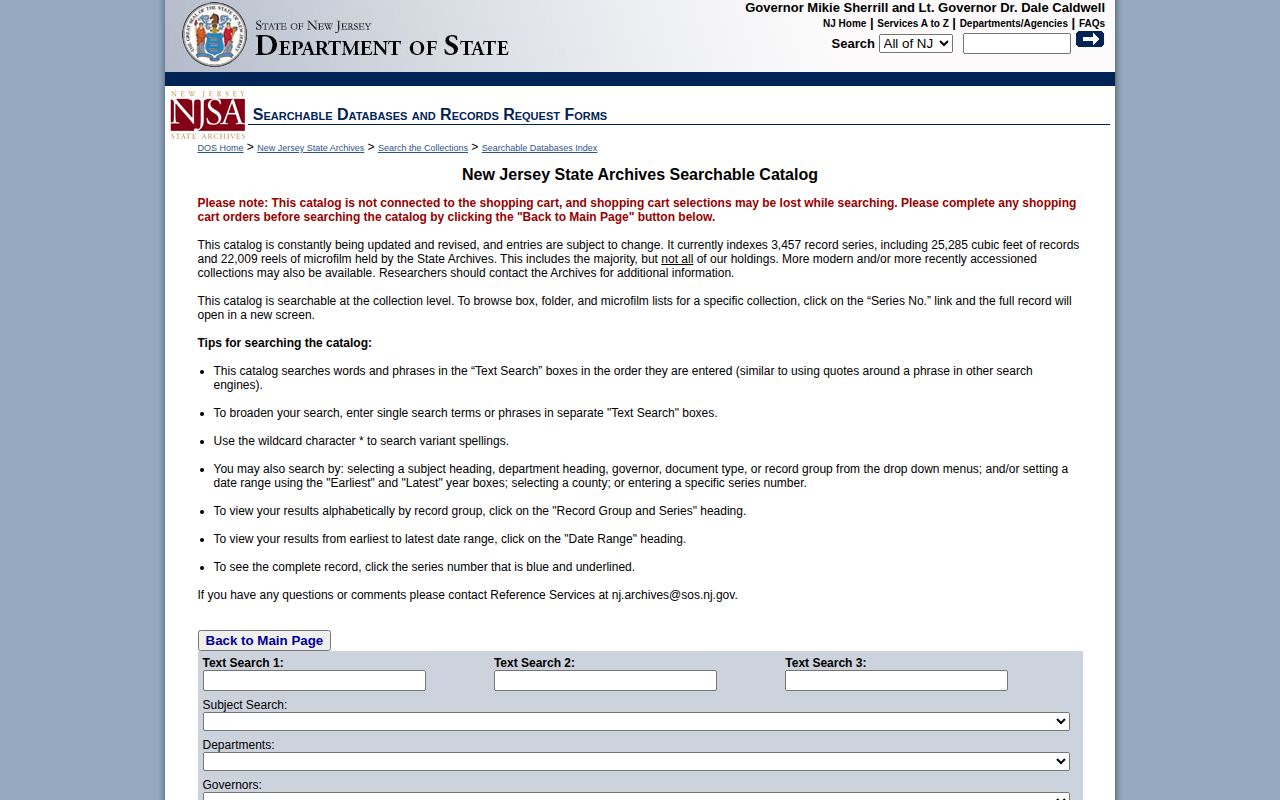
The catalog helps you locate a series first. Then make your request. Search by agency or institution name, not just record type. Useful terms include many prison and agency names. Try New Jersey State Prison, State Prison at Trenton, Department of Institutions and Agencies, New Jersey State Reformatory for Women at Clinton, Edna Mahan, inmate records, photographs, admission registers, identification files, and prison records. A search for "mugshot" alone misses material cataloged under a prison or record series. The New Jersey State Archives Catalog offers many search options. Use text, subject, department, record group, and date range. The page displays the search interface itself, not faces. Each result points to records staff may retrieve. It does not mean an individual photograph is digitized or online.
| Collection | Where | Era covered | How to access |
|---|---|---|---|
| Clinton reformatory inmate records, SINCL003 | State Archives collection | 1910s–1970s | Search the control number and confirm which boxes or files remain open. |
| Clinton reformatory photographs, SINCL005 | State Archives collection | 1910s–1960s | Ask whether an item covers the person and can be viewed or copied. |
| Other correctional series | State Archives catalog, by institution or record group | Varies by series | Search agency names, then ask staff about the series description. |
| County or municipal booking files | Originating agency, county clerk, or local historical collection | Varies; no common statewide range | Ask the custodian whether the record was kept or transferred. |
Treat the Clinton entries as concrete leads rather than a name index. Collection dates describe the material, not the availability of one booking portrait. Before visiting or requesting copies, ask the Archives whether a record is open, whether the box list is complete, and whether a photograph sits in the described file.
Note: A catalog entry can describe registers, correspondence, or institutional photographs without naming the people shown in each item.
New Jersey’s Clinton Correctional Collection
The cataloged New Jersey State Reformatory for Women at Clinton collection shows how this works. It lists inmate records from the 1910s through the 1970s under control number SINCL003. Photographs from the 1910s through the 1960s fall under SINCL005. Those date ranges help narrow a search considerably. Not every person held there has a file. Nor is each photograph a true booking image.
When contacting staff, give the institution's name and both control numbers. They can confirm whether a box description matches the dates and record type you need. An "inmate record" may contain no image at all. A photograph series may hold views or portraits untied to any named intake. Only the catalog and its staff determine what the collection contains at the item level.
Other searches can try a few more terms. Consider State Prison at Trenton, New Jersey State Prison, or the former Department of Institutions and Agencies. These are search terms. They are not proof a specific file exists. Staff can also tell a finding aid apart from a box actually open for research.
New Jersey Booking Photo Retention
The published detention schedule offers a narrow view. Still, it shows how long jail records last. C280000-002 is a New Jersey retention schedule. It lists the Photo Card File or Index at 10 years after disposition or release. The Inmate History File, Identification File gets the same 10-year period. The Daily Working File portion lasts only three years after release. Jail Commitment Registers, by contrast, are listed as permanent agency records.
| Record in the schedule | Listed retention | What that does not promise |
|---|---|---|
| Photo Card File or Index | 10 years after disposition or release | That every county posts the image online for that long. |
| Inmate History File, Identification File | 10 years after disposition or release | That the record is transferred to the State Archives when the period ends. |
| Inmate History File, Daily Working File | 3 years after release | That all supporting papers follow the same schedule. |
| Jail Commitment Registers | Permanent agency retention | That each register includes a photo or is held by a state archive. |
A case disposition is simply the recorded outcome, whether a dismissal, a plea, or a judgment. Every agency sets its own retention schedule. So one county's rule cannot be applied to another sheriff or to every photograph across New Jersey. Retention and web access are two separate things, too. An office can pull an image from public view yet keep the underlying record in a file. A page can vanish while the source file survives. Old images turn up in identification files, jail admission books, court exhibits, prosecutor releases, commitment registers, newspaper archives, and historical society holdings. Treat those as leads rather than a guaranteed inventory. A missing web result does not mean destruction. A catalog entry does not guarantee a surviving public photo either.
Note: The published schedule covers the records it names and the agencies to which it applies, not every local custodian in New Jersey.
How to Request New Jersey Archive Records
Keep the first request narrow. A name by itself rarely pins down an old file, since institutions processed countless people over long spans. Collect the full name plus alternate spellings, the arrest or custody era, the county or municipality, the likely agency, and any case or control number. Ask up front whether the series is open and whether staff can run the search for you. The State Archives search and contact page shows the current access details for researchers. Check that page for contact options and visit planning. Procedures shift over time. Confirm access before you travel. The answer may hinge on a staff review or one specific box.
- Search the Archives catalog by institution, agency, series title, control number, and date range. Try the institution’s historic name as well as its current name.
- Record the exact series or control number, dates, box or item description, and whether the entry says inmate records, photographs, registers, or correspondence.
- Contact the Archives through its current search and contact page. Ask whether the item is open, whether the dates are present, whether staff can search, and whether an appointment is needed.
- Request only the record or image that fits the description. Ask about a scan or reproduction estimate, privacy limits, conservation needs, copyright, and any access restriction.
- For a county or municipal record, contact the originating agency, county clerk, historical society, or local newspaper archive. Ask if the file was kept or transferred, since the State Archives does not hold every local booking photo.
Walking in to research at the State Archives is generally free. Copies and reprographic work can cost money. Fees vary by service, so request an estimate first. Mail research is offered, and appointments can be booked. Ask how long a staff search takes, since the Archives must first locate the right series and confirm its access terms allow inspection or reproduction. Request the specific arrest register, booking file, or cataloged photograph by name. If no image is listed, ask about related files. An identification file or register might fill the gap. Precision saves everyone time. When a local agency held the record originally, check with that office before assuming the State Archives holds a copy.
What New Jersey Archive Records Survive
New Jersey offers no statewide digitized mugshot-book interface. The State Archives online catalog helps you find descriptions and request material. Paper records and microfilm may still need staff help. A visit may be required too. A collection can match your dates yet hold gaps in names, boxes, or photographs. Privacy rules, conservation limits, copyright, or access terms may also restrict viewing or copying.
Historic arrest records still need context. "Disposition" is the court's recorded result. Verify a reliable case source before describing what happened. Do not publish a face merely because an old photo surfaces in a collection. For a county-held record, identify the agency and use the New Jersey County Directory to reach that jurisdiction's current record path. The statewide home page explains recent roster and feed limits. The Archives route covers older records and transferred collections.